
Kabaddi: Rules, History and the Reinvention of an Ancient Sport
कबड्डी क्या है? — यह एक संपर्क टीम खेल है जिसमें सात-सात खिलाड़ियों की दो टीमें होती हैं। एक रेडर विपक्षी आधे हिस्से में जाकर ‘कबड्डी’ का उच्चारण करते हुए डिफेंडर को छूकर अंक लेता है और सुरक्षित लौटता है। कबड्डी का मैदान कितना बड़ा होता है? — पुरुषों के लिए मैट 13 मीटर × 10 मीटर और महिलाओं के लिए 12 मीटर × 8 मीटर होता है। मैट के दोनों किनारों पर एक-एक मीटर चौड़ी लॉबी होती है। एक रेड कितने सेकंड की होती है? — अधिकतम 30 सेकंड। इस दौरान रेडर को लगातार ‘कबड्डी’ कहते रहना अनिवार्य है; रुकना या साँस रोकना फ़ाउल है। कबड्डी में अंक कैसे मिलते हैं? — टच या बोनस पर 1 अंक, सफल टैकल पर 1 अंक, सुपर टैकल पर 2 अंक, और ऑल आउट पर 2 अंक। डू-ऑर-डाई रेड क्या है? — लगातार दो खाली रेड के बाद तीसरी रेड अनिवार्य हो जाती है; रेडर को अंक लेना ही होता है, वरना वह आउट हो जाता है। सुपर टैकल क्या है? — जब मैट पर तीन या उससे कम डिफेंडर बचे हों और वे रेडर को रोक दें, तो टीम को 2 अंक मिलते हैं। कबड्डी कब एशियाई खेलों में शामिल हुई? — 1990 के बीजिंग एशियाई खेलों में। प्रो कबड्डी लीग कब शुरू हुई? — 2014 में, आठ फ्रैंचाइज़ी टीमों के साथ; बाद में यह बारह टीमों तक विस्तारित हुई। कबड्डी के प्रमुख प्रारूप कौन-से हैं? — स्टैंडर्ड स्टाइल (मैट पर, PKL और अंतरराष्ट्रीय प्रतियोगिताओं में), सर्कल स्टाइल (गोलाकार मिट्टी के मैदान पर) और बीच कबड्डी (रेत पर)। कबड्डी में सबसे आम चोटें क्या हैं? — टखने की मोच, घुटने के लिगामेंट की चोट, कंधे की चोट और पेशीय खिंचाव।
Kabaddi is one of the few sports in the world with no ball, no bat, no racket and no goalpost. Just a court, seven players a side, and a single breath. The raider must enter the opponent's half while chanting kabaddi-kabaddi continuously, touch a defender, and return safely. That simplicity is the sport's strength and its cruelty.
Kabaddi has been played in India for centuries on village fields and school grounds, but the last decade has transformed it. Television broadcast, franchise leagues, data-driven coaching and professional scouting have turned a local pastime into a product with its own star economy. It has a permanent place in the Asian Games, there are World Cups, and the Pro Kabaddi League is among the most-watched league sports in India.
This article is not a report of a single match or tournament. It is an attempt to explain the framework the sport rests on: rules, strategy, history and its present form.
Name and Origins
The etymology of the word kabaddi is disputed. One common explanation links it to the Tamil kai-pidi, meaning to hold by the hand. Others connect it to traditional chants such as hu-tu-tu in Marathi. The sport is known by different names across states: hu-tu-tu in Maharashtra, kaudi in Punjab, ha-du-du in Bengal, sadugudu in Tamil Nadu and chedugudu in Karnataka.
Popular belief ties it to the chakravyuh episode of the Mahabharata, where Abhimanyu entered the enemy formation alone. That is a metaphor, not historical evidence. What is more concrete is that the organised, rule-bound form of kabaddi took shape only in the twentieth century.
Modern kabaddi's organisation is credited in large part to efforts in Maharashtra and surrounding regions, where the move to standardise the game began. A demonstration was held at the 2026 Berlin Olympics, regarded as the sport's first major international appearance. National federations followed, rules were written down, and kabaddi became an official sport at the 2026 Beijing Asian Games.
Court and Mat
Traditional kabaddi is played on clay, with the ground prepared using a mixture of water and dung to reduce slipping. Competitive kabaddi is now played on a mat, which offers better grip, safety and a broadcast-friendly surface.
For men, the mat is 13 metres long and 10 metres wide. For women, it is 12 metres by 8 metres. A midline divides the mat into two halves. The baulk line sits roughly three and three-quarter metres from the midline, with the bonus line one metre behind it. Both edges of the mat have a one-metre-wide lobby, an area where no defender can hide during a raid but where players can move once contact is broken.
Raiding: A Thirty-Second Test
At the start of a raid the raider must continuously chant kabaddi. Holding the breath, pausing or falling silent is a foul. A raid lasts a maximum of 30 seconds, within which the raider must enter the opponent's half, score, or return.
Points can be earned four main ways. First, a touch: the raider touches any part of a defender's body and returns safely. Second, a bonus: if six or more defenders are on the mat and the raider crosses the bonus line, one point is awarded. Third, a super raid: three or more points in a single raid. Fourth, an all-out: every opponent being put out at once.
The do-or-die raid is the most tense moment in modern kabaddi. If a team plays two consecutive empty raids, the third becomes do-or-die: the raider must score, or he is out. This rule has sped up the game, raised the risk, and made it more dramatic for viewers.
Defence: The Art of the Catch
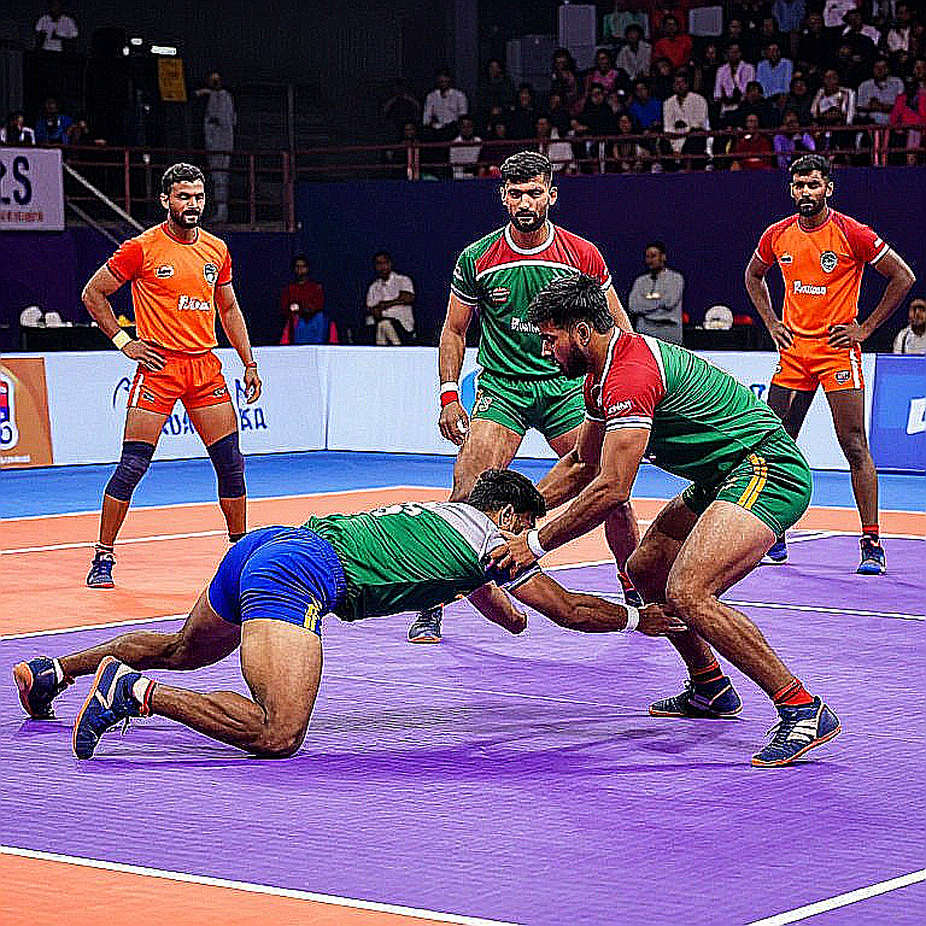
Half of kabaddi is defence. The defender's aim is to catch the raider, surround him and pin him to the mat so that a return becomes impossible.
The most common tackle is the ankle hold, in which a defender grabs the raider's foot or ankle. A thigh hold targets the thigh. A waist hold targets the torso. Alongside these are running hand touches, blocks and chain tackles, where defenders link hands to form a chain.
A super tackle is awarded when three or fewer defenders remain on the mat and they stop the raider: two points. This rule keeps the game balanced; otherwise attacking a depleted team would be a free advantage for any raider.
The biggest challenge in defence is the fear of being touched. Modern coaching focuses heavily on this, teaching defenders when to retreat and when to commit.
Scoring and Match Format
A touch or a bonus earns one point. A successful tackle earns one point, a super tackle two, and an all-out two. A match is played in two halves of 20 minutes with a five-minute break.
An all-out is the most decisive moment. When all seven players of a team are out, the opponents get two points and the eliminated team's seven players return to the mat. It follows that being down to the last man is both the most dangerous and the most heroic situation in kabaddi.
Team Structure
Seven players are on the mat at once. In league formats a squad is usually 12 players: seven playing and five in reserve. Substitutions are limited and often tactical, used to introduce a specialist raider or add defensive strength.
A balanced team has three or four raiders, three defenders and one or two all-rounders. Balance matters because a team reliant only on raiding collapses after an all-out, while a team reliant only on defence struggles to score at all.
Fouls and Discipline
The rules on fouls are strict. A raider must chant continuously; pausing or holding the breath is illegal. A defender may not pull the raider's shorts, jersey or hair; strangling, covering the mouth, or deliberately pushing a player off the mat are prohibited. Entering the lobby during a raid is treated as a violation.
Depending on the situation, a foul can result in the raider or defender being out, or the opposing team receiving extra points. The referee's decision is decisive, which is why video referral and technical review have grown in importance.
The Impact of the Pro Kabaddi League
Launched in 2026, the Pro Kabaddi League (PKL) has changed the sport in a way that is extraordinary in Indian sporting history. It began with eight franchises, later expanded to twelve, and popularised the game across the country.
Its greatest contribution is technical. Kabaddi statistics were once very limited; now every raid, every tackle and every player's success rate is recorded. This brought matchup-based strategy: which raider is effective against which defender, which team starts slowly in the first half, which player has the best do-or-die conversion rate.
Its second contribution is branding. Names such as Pardeep Narwal, Anup Kumar, Ajay Thakur, Rahul Chaudhari and Manjeet Chhillar moved beyond the domestic game and became television stars. The participation of foreign players enriched the sport too: Iranian defenders such as Fazel Atrachali are as popular with Indian audiences as domestic players.
Its third contribution is economic. The league gave players a career path that once depended on government jobs and departmental teams.
The International Picture
Kabaddi has been part of the Asian Games since 2026. India was long its dominant nation, but Iran has mounted a serious challenge in recent years. At the 2026 Jakarta Asian Games, Iran won gold and India was limited to bronze: a turning point in the sport's history. India returned to win gold at the 2026 Hangzhou Asian Games.
Beyond Iran, the sport's base is growing in South Korea, Bangladesh, Thailand, Japan, Poland and Kenya. Leagues are emerging outside India as well, though none at the scale of the PKL.
Forms of the Game
Competitive kabaddi has two main forms: standard style, played on a mat and used in the PKL and international competition; and circle style, played on a circular clay field and linked to Punjab's traditional circuit. Beach kabaddi, played on sand, is also growing and has featured in the Asian Beach Games.
Women's Kabaddi
Women's kabaddi is advancing quickly. A women's event was added to the Asian Games in 2026, and the Indian women's team has performed strongly. Domestically, the network of national championships and age-group competitions has expanded. Challenges remain: gaps in coverage, sponsorship and prize money, and the need for a safe training environment.
Fitness and Injury
Kabaddi is physically demanding. Raiding requires explosive speed, the ability to change direction, and strength; defence demands endurance, grip strength and team coordination.
The most common injuries are ankle sprains, knee ligament damage, shoulder injuries and muscle strains. Playing on a mat reduces slipping, but the tendency to fall and collide at speed remains. Modern teams treat warm-ups, mobility work and recovery protocols as mandatory.
Scouting and Coaching
Traditionally, kabaddi players came straight from villages and schools. Scouting is now organised: league teams track players through regional trials, youth championships and university tournaments.
Coaching has changed too. Decisions once rested on experience and intuition; now data is used to study an opposing raider's favourite touches, his habit of avoiding ankle holds, and a defender's positional strengths. This has brought a culture of matchups and plan B.
Challenges
Kabaddi faces concrete challenges. First, geographic spread: despite the PKL's popularity, the sport remains largely centred on India and Iran. Second, player careers: outside the league, the structure for steady income is weak. Third, transparency and governance: calls for clarity in selection, contracts and decisions persist. Fourth, competition for broadcast attention: against cricket's commercial dominance, kabaddi must constantly hold its audience.
Why the Sport Will Grow
Kabaddi's greatest strength is its accessibility. It needs no expensive equipment: a ground, seven players, and that is enough. This is why it has survived for centuries in rural South Asia and will continue to.
Its second strength is watchability. Thirty seconds of a raid contain the whole drama: solitude, risk, and instant decisions. The Pro Kabaddi League packaged that drama well and found viewers.
Its third strength is technology. Hawk-Eye, better camera angles, graphics and the availability of statistics have made the sport analysable: a viewer now tracks not only a favourite team but a favourite raider's success rate.
Finally, kabaddi matters because it represents a category of Indian sport that usually stays at the margins: rural, low-resource, collective. Its professionalisation does not change where its roots lie. Both are true at once, and perhaps that is the most interesting thing about the game.
संबंधित खिलाड़ी
अनुशंसित
Commonwealth Kabaddi Championship: India's first test is England, not the medal2026-10-26
England Scored 68 Against Nigeria and 26 Against India: That 42-Point Gap Is India's Real Strength2026-10-27
41 Tackles, 33 Planted Feet: How a Kabaddi Ankle Breaks, and Why We Still Call It Slippage2026-11-02
The Full Map of Kabaddi: From the Akhada to the League, from Rules to Economics2026-10-31
Commonwealth Kabaddi Championship: Ahmedabad's 62-Match List, and the Number That Thins the 13-Nation Claim2026-10-29
अनुशंसित
Surjeet Singh Captain, Naveen Kumar Deputy: Three Blank Lines in the Ahmedabad Announcement2026-10-23
In Kabaddi, Injury Is Not Fate — It Is a Protocol Story2026-11-03
First Commonwealth Kabaddi Championship in Ahmedabad: Indian women face Malaysia, men take on England2026-10-28
The Third Raid, the Fourth Match, and a Hollowed-Out Crown: What the Scoreboard Won't Tell You Before India vs England in Ahmedabad2026-10-24
अनुशंसित
Jakarta's 27-24 Is Not in Any Server: The Empty Ledger of Women's Kabaddi2026-10-25
41 Tackles, 33 Planted Feet: How a Kabaddi Ankle Breaks, and Why We Still Call It Slippage2026-11-02
Commonwealth Kabaddi Championship: India's first test is England, not the medal2026-10-26
Commonwealth Kabaddi: Beating Nigeria Is Easy, But India's Real Question Is Its Defence2026-11-03
Commonwealth Kabaddi Championship: Ahmedabad's 62-Match List, and the Number That Thins the 13-Nation Claim2026-10-29
अनुशंसित
Kabaddi: From Mud Courts to the Global Stage, India's Most Popular Indigenous Sport2026-10-31
Ahmedabad's Match 4, India's First Audit: Squad Depth Is the Real Question, Not the Scoreline2026-10-26
Surjeet Singh Captain, Naveen Kumar Deputy: Three Blank Lines in the Ahmedabad Announcement2026-10-23
Behind the Blank Screen: Pipeline Failure and the Real Crisis in Kabaddi Coverage2026-11-01
Ahmedabad Day 1: The Scoreboard Is Right, the Table Is Incomplete2026-10-24